

If you are tracking yellow formwork panel price, do not stop at the ticket number. A panel can look cheap and still cost you more each week. Labor, cleaning, repairs, and handling decide the real spend. So, the best buyers compare cost per pour, not only sheet price.
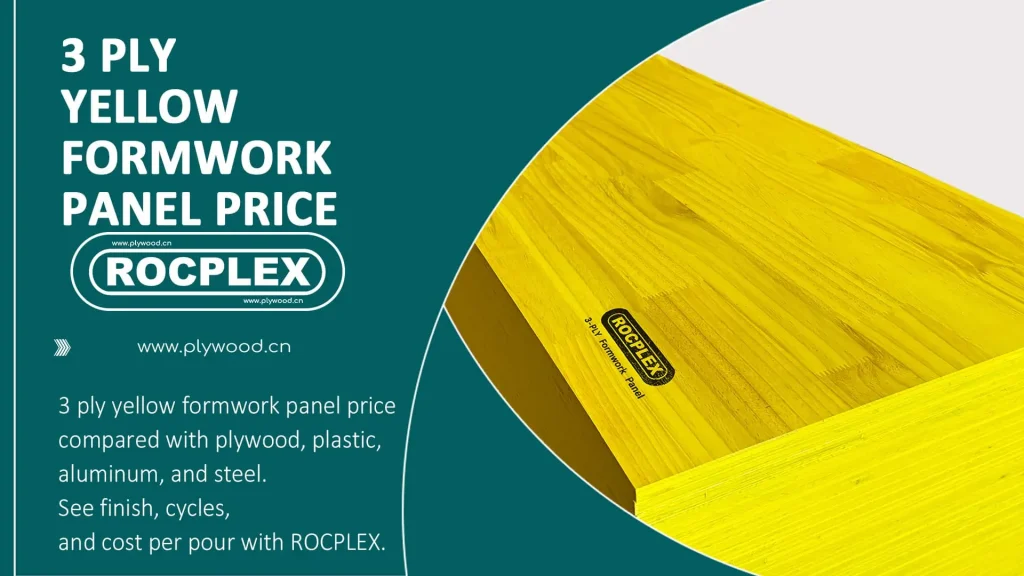
This guide explains what drives price, how to estimate real value, and how ROCPLEX controls quality to protect reuse cycles. It also covers when a three-ply panel makes sense versus film faced plywood, plastic, aluminum, or steel.
1) Yellow formwork panel price is not the full cost
A quote tells you what you pay today. However, the job pays again through time and waste.
These items shape real cost:
- Strip time per pour
- Cleaning time after stripping
- Repair time at edges and corners
- Transport cost linked to weight
- Waste from cut-outs and damage
- Finish rework in visible areas
When you add these factors, yellow formwork panel price becomes only one line in the budget.
2) 3 ply yellow formwork panel price: what drives it
The 3 ply yellow formwork panel price changes for clear reasons. You can track most of them.
Veneer and fiber grade
Better veneer improves flatness and stability. As a result, sheets fit frames more easily and stay usable for more cycles.
Glue type and glue spread
A strong glue system protects bonds in wet and alkaline conditions. Even more important, glue spread must stay even. Uneven spread leads to weak zones and early failure.
Face rules and patch limits
Face standards control knot limits and patch counts. Therefore, they influence finish quality and the time you spend on touch-ups.
Edge sealing
Edges take daily hits. Water enters at cuts. Paste rides the edge. Impacts break corners. A strong seal slows swelling and supports reuse.
Size and thickness
Sheet size affects handling and coverage speed. Thickness affects stiffness, span, and weight. So, size and thickness can change both labor and freight.
Freight distance and market demand
Freight cost moves with route and fuel. Demand shifts base costs as well. That is normal. What matters is how well the panel holds value after multiple pours.
3) Three ply shuttering panel cost vs. cost per pour
Many teams compare a three ply shuttering panel cost line by line. That method misses the bigger savings.
A better method is simple:
Cost per pour = (Panel price ÷ reuses) + labor + cleaning + repair + transport + waste
To use it on site:
- Start with sheet price or price per m²
- Set expected reuses by zone
- Add minutes for strip and wipe
- Add edge reseal and patch time
- Add transport cost linked to weight
- Add waste from cut-outs and damage
This is the fastest way to judge value.
4) ROCPLEX controls that protect yellow formwork panel pricing
Stable quality helps you predict cycles. Predictable cycles protect cost per pour. ROCPLEX focuses on controls that match real site pain points.
Moisture control that keeps sheets stable
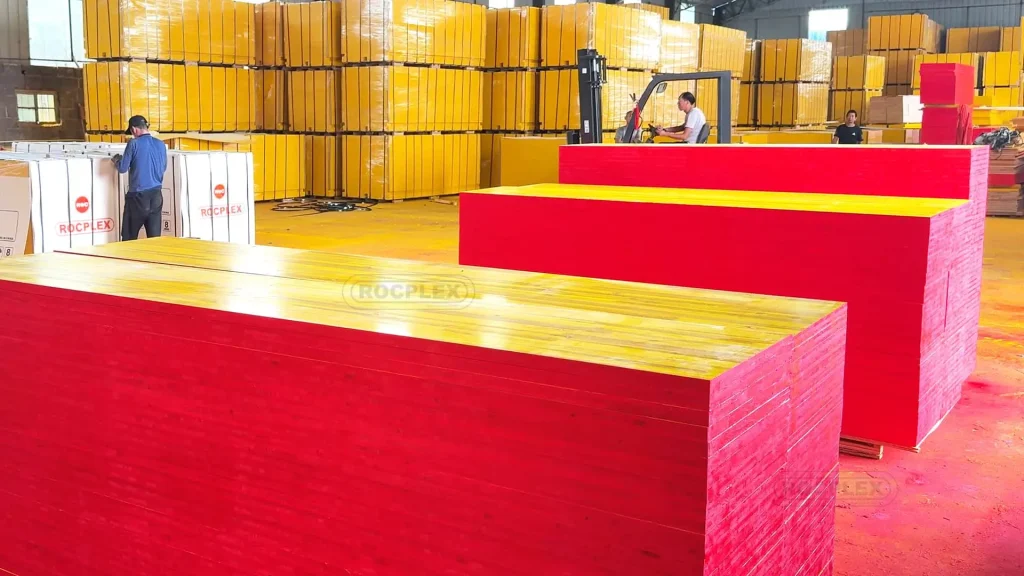
ROCPLEX keeps veneer moisture within range. This step reduces warping and edge lift. Therefore, sheets sit flatter and keep better contact in frames.
Consistent bonding for repeat cycles
Uniform glue spread improves bond consistency. As a result, panels resist peeling and delamination in wet work.
Press control for thickness accuracy
Press time and heat lock thickness. That consistency improves fit and reduces rocking edges. It also lowers the risk of gaps and leaks.
Full edge sealing for cut protection
Edge seal slows water entry at cuts and corners. In addition, it buys you time when weather turns bad or storage gets crowded.
Batch labels and traceability
Clear labels help site teams check grade and batch quickly. Traceability also supports repeat orders with consistent output.
These steps help the yellow formwork panel price work harder across more pours.

5) 3 ply yellow formwork panel price vs film faced plywood
Film faced plywood serves many jobs. It has a hard film and a smooth surface. Still, film can chip at edges. Heavy paste can also increase cleaning time. In some cases, higher sheet weight slows manual handling.
A three-ply panel often feels lighter for manual work. It can also be faster to trim and reseal on site. That matters in mixed geometry and quick cycles.
Best use plan
- Use film faced plywood in high-wear zones
- Use three-ply yellow panels for slabs, infills, edges, and detail work
- Mix systems by zone to balance speed and wear life
This approach often lowers total 3 ply panel price pressure because labor drops.
6) Yellow formwork panel pricing vs plastic modular formwork
Plastic resists water by nature. It can wash easily. However, wide spans can flex, and module parts may cost more. Heat and sun can also mark surfaces on some sites.
Wood sheets keep freedom. You can cut openings fast with standard tools. Repairs also stay quick and low cost.
Choose plastic when repetition is very high and layouts stay fixed. Choose three-ply panels when openings and changes happen daily.
7) Formwork board price vs aluminum frames vs steel panels
Aluminum frame systems
Aluminum can run fast on repeats. Still, upfront spend is high, and training takes time. Custom parts can also limit last-minute layout changes.
Three-ply panels stay flexible. You can cut and fit without special jigs. Many teams use aluminum for cores, then use three-ply panels for slabs and details.
Steel panels
Steel gives very flat faces and long life. Yet weight often demands cranes or extra labor. Repairs may require welding.
Three-ply panels support human-scale work. Two people can move sheets on short cycles. For many pours, that speed reduces total cost even if steel lasts longer.
So, compare systems using cost per pour, not only formwork board price.
8) Finish class and surface look for three-ply formwork panel price
Owners care about finish on visible zones. Architects check wall faces and edges. So, face grade matters.
Better face control reduces:
- patch work
- grinding
- touch-up time
- delay at handover
Release oil also matters. Apply it thin and even. Too much oil can attract paste and increase cleaning time. Thin coats support clean release and better cycles.
This is where the 3 ply yellow formwork panel price can deliver strong value. You pay for stability and save on rework.
9) Handling and safety benefits that cut real cost
Lower sheet weight reduces strain. It also improves manual speed between zones. That can reduce overtime and injury risk.
Other practical benefits:
- Standard saws and drills work well
- No hot works needed for basic trims
- Sealed edges feel smoother in handling
- Less fatigue supports steady output
Safety gains protect budgets. They also protect schedules.
10) Moisture, edges, and care rules that increase reuse cycles
Water is the daily enemy. Rain hits stacks. Concrete paste stays wet and alkaline. Good habits protect cycles.
Use these rules:
- Store sheets on dunnage, not on ground
- Cover the top, but keep side airflow
- Wipe faces before storage
- Reseal fresh cuts the same day
- Rotate panels by zone to spread wear
- Keep a simple edge-seal kit on site
These steps cost little. However, they can add many cycles. That is the fastest way to improve yellow formwork panel price outcomes.
11) Buying checklist before you request a quote
To get a clean quote and avoid surprises, share:
- Finish class by zone
- Support spacing and frame type
- Crew size and lift method
- Release agent choice and method
- Cleaning plan and tools
- Storage plan with airflow
- Expected reuses by zone
- Repair plan and spare ratio
With this information, ROCPLEX can quote the correct spec, not a generic sheet.
12) People Also Ask about 3 ply yellow formwork panel price
Is the price the biggest lever?
Not alone. Labor, reset speed, and damage rate often decide cost per pour.
How many cycles are realistic?
Care and release oil habits decide the range. Good storage and quick reseal lift reuse count.
Will rain ruin edges?
Not if edge sealing is strong and storage is correct. Reseal fresh cuts fast.
Can I use it on high walls?
Yes, within design loads and spacing. Strong frames and proper bracing matter.
Does size change pricing?
Yes. Larger sheets raise freight and handling needs. Yet they can reduce joints and labor.
13) Next steps for ROCPLEX pricing
If you want an accurate quote, send drawings, target finish zones, and delivery dates. ROCPLEX will return a clear offer with specs, packing details, and care guidance.
You will receive a practical 3 ply yellow formwork panel price quote that supports real site decisions, not guesswork.
Quick comparison table (helps Yoast readability and time-on-page)
| Factor | 3-Ply Yellow (ROCPLEX) | Film Faced Plywood | Plastic Modular | Aluminum Frame | Steel Panel |
|---|---|---|---|---|---|
| Handling weight | Light | Medium | Medium | Light | Very heavy |
| Setup speed | Fast | Medium | Fast on repeats | Very fast on repeats | Slow |
| Repair effort | Quick | Moderate | Costly parts | Specialist parts | Welding |
| Best use | Mixed geometry | High wear zones | Fixed repeats | Towers/cores | High pressure zones |
| Cost driver | Labor + cycles | Wear life | Module cost | Upfront + training | Lifting + labor |
- FSC – Forest Stewardship Council
- APA – The Engineered Wood Association
- OSHA – Construction Safety Resources
Post time: Jan-19-2026