

Film faced plywood reuse cycles can vary widely. A low grade panel may only survive a few pours, while a high grade panel can be reused many more times when the face, core, glue line, edges, stripping method, release agent, and storage routine are controlled. ROCPLEX Form Birch states a typical range of 20 to 80 cycles, depending on site handling and care.
This is why buyers should not judge film faced plywood by sheet price alone. The real measure is cost per pour. A panel with a higher unit price can still be more economical if it releases cleanly, stays flat, resists edge swelling, and avoids early replacement.
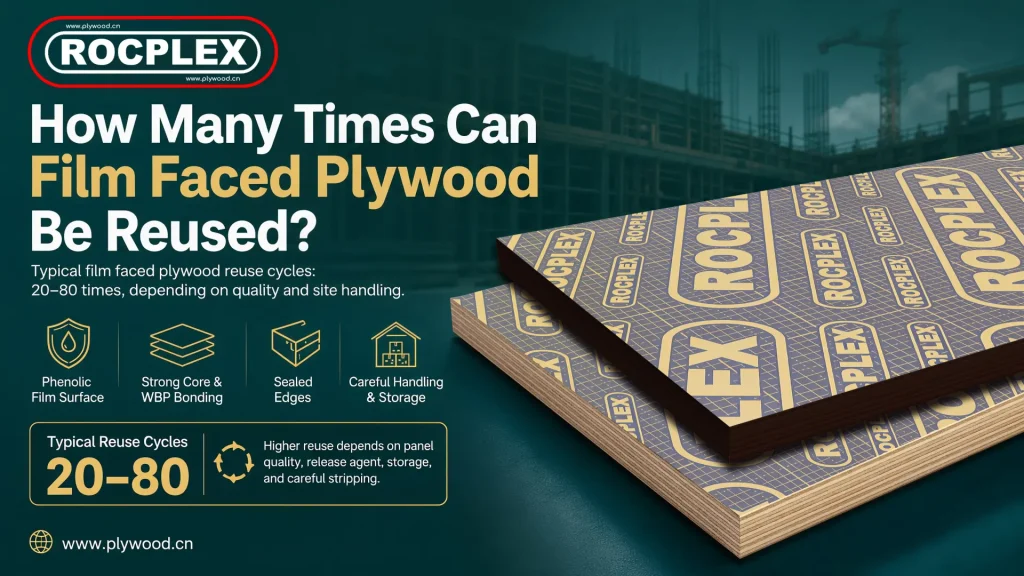
Why reuse cycle claims vary so much
Many suppliers give reuse numbers, but those numbers are not always based on the same conditions. One supplier may talk about light slab work. Another may refer to wall formwork with careful handling. A third may count only limited test use, not full site routines.
Fresh concrete is heavy, wet, and abrasive. Panels face pressure, vibration, nail damage, release oil, cleaning, sunlight, rain, yard transport, and forklift handling. Each step can reduce the next reuse cycle if the panel is not built and handled well.
So the better question is not only “how many times can it be reused?” The better question is “what product build and site routine are needed to reach the target cycle range?” That question gives buyers a safer way to compare quotes.
The film surface affects release and face wear
The film surface is the first layer that touches concrete. A stronger phenolic film helps reduce sticking and slows face wear. This supports cleaner release after stripping and helps protect the panel face during repeat pours.
ROCPLEX Form Birch uses 220 g/m² phenolic film on both sides. This matters because film weight gives buyers a clearer specification than colour alone. Black film faced plywood and brown film faced plywood can both work well, but colour does not prove cycle life by itself.
For smooth concrete finish, crews should also clean the face after use. Dried cement, sand, and hard scraping can damage the film surface. A good panel still needs good handling to keep the face useful across repeat cycles.
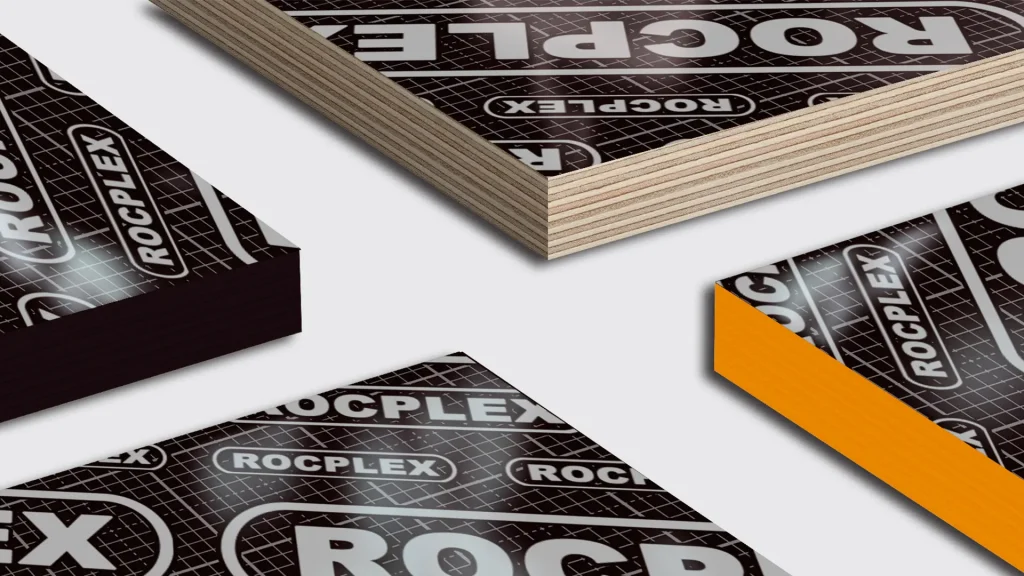
The core decides whether the panel stays stable
A durable face cannot perform well on a weak core. The core affects stiffness, flatness, screw holding, edge strength, and resistance to repeated wet and dry movement. Core gaps, poor veneers, or uneven pressing can shorten formwork plywood reuse fast.
Full birch construction is often selected for demanding concrete formwork because it supports stiffness and stable shape. For wall and slab routines, this helps the panel stay more predictable after repeated stripping and transport.
Buyers should ask what core is used, how the veneers are arranged, and whether the supplier can keep the same build across repeat orders. Stable batch quality is vital for wholesalers, rental fleets, and contractors with large formwork programs.
WBP bonding protects the panel during wet work
Bonding is one of the most important points in film faced plywood reuse cycles. Concrete work exposes the panel to moisture. If the glue line is weak, delamination can begin. Once that happens, reuse drops quickly and site complaints become harder to solve.
WBP film faced plywood is made for wet formwork routines. ROCPLEX Form Birch uses A bond WBP bonding for concrete formwork use. Buyers should include bonding requirements in the RFQ, especially when panels are used in humid, rainy, coastal, or high cycle projects.
For broader formwork planning, buyers can review the ACI Guide to Formwork for Concrete, which covers quality, economy, design, construction, and materials for formwork work.
Edge sealing often decides early failure risk
Edges often fail before the face. Water can enter through open sides, fresh cut edges, nail holes, damaged corners, or poor storage. Once the edges swell, panels may lose shape and become harder to fit back into the formwork system.
This is why sealed edges are not just a cosmetic detail. ROCPLEX Form Birch uses multi coat sealed edges to slow water entry. If panels are cut on site, the new cut edges should be resealed before the next use.
Many reuse problems start at the edge, not the middle of the sheet. Buyers who want more cycles should check edge coating, packing protection, and corner damage before accepting a shipment.
Site handling can double or halve the useful life
Even a premium panel can fail early if crews handle it badly. Harsh stripping, metal tools, dragging on rough ground, long sun exposure, standing water, and poor stacking all reduce reuse life. Good site care protects the money already spent on panels.
Crews should use a suitable release agent, strip panels without tearing the face, clean them soon after use, stack them flat, keep them off the ground, and cover them from weather. Corners should be protected during lifting and transport.
Cutting also needs care. If panels are trimmed to fit a special form, cut sides should be resealed. Otherwise, the panel may absorb moisture through the fresh edge and fail faster than expected.
Cost per pour is the real buying measure
Reuse only matters because it changes project cost. Cost per pour gives buyers a better way to compare panels. A cheaper sheet may look attractive, but it can cost more if it fails after limited use, leaves marks, or slows the site team.
| Buyer factor | Effect on reuse cycles | Risk if ignored |
|---|---|---|
| Phenolic film | Supports cleaner release and slower face wear | Sticking, rough finish, early face damage |
| Core quality | Helps panel stay flat and strong | Bending, voids, weak edges, short life |
| WBP bonding | Reduces delamination risk in wet work | Layer separation and fast panel failure |
| Edge sealing | Slows water entry at sides | Swelling, corner damage, poor system fit |
| Release agent | Helps stripping and protects the film | Concrete sticking and surface tearing |
| Storage routine | Keeps panels dry, flat, and clean | Warping, moisture damage, face staining |
For buyers, the strongest offer is not always the lowest price. It is the offer with the clearest specification, realistic reuse target, stable packing plan, and repeat order control.
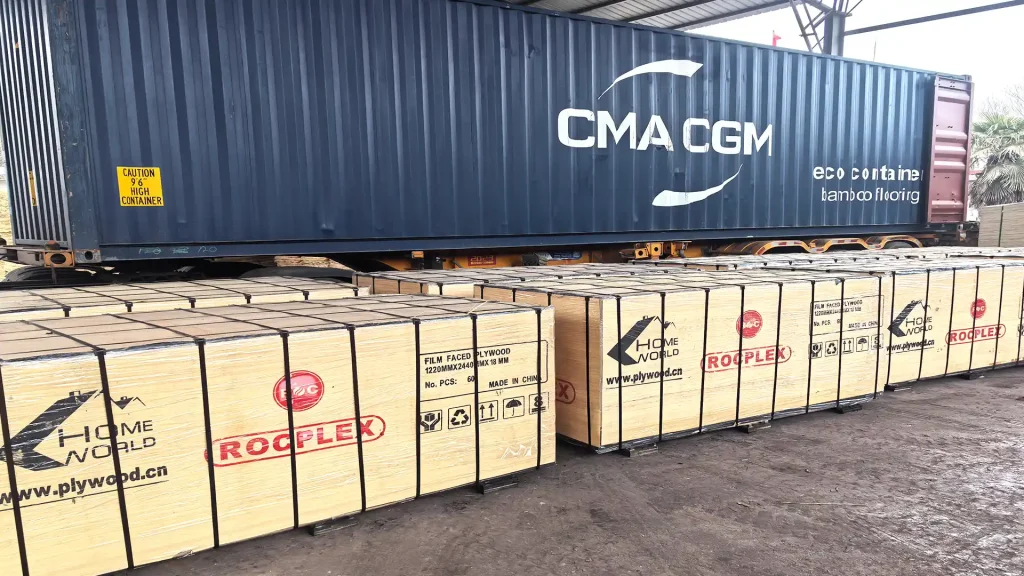
How to specify panels for repeat pour programs
A repeat pour program needs more than a product name. Buyers should state the job type, panel size, thickness, target cycles, concrete finish level, film colour, film weight, core requirement, WBP bonding, edge sealing, packing needs, and destination port.
They should also state document needs early. Some markets or tenders may require FSC or PEFC Chain of Custody support. FSC explains that Chain of Custody certification tracks forest based materials through the supply chain. PEFC also sets procedures for purchasing, tracking, manufacturing, sale, and records of certified materials.
For full concrete formwork systems, buyers may also compare panels with H20 formwork beams, formwork plywood, and formply. Matching the panel with the right support system helps protect finish, alignment, and schedule.
FAQ about film faced plywood reuse cycles
How many times can film faced plywood be reused?
High grade film faced plywood may be reused many times. ROCPLEX Form Birch states a typical range of 20 to 80 cycles, depending on handling and care.
What affects film faced plywood reuse the most?
The main factors are film quality, core strength, WBP bonding, edge sealing, release agent, stripping method, cleaning, storage, and transport.
Can low cost film faced plywood be reused many times?
Sometimes, but often not. A low cost panel may have weaker film, core, bonding, or edge protection, which can reduce real cycle life.
How can builders extend reuse cycles?
Use release agent, strip carefully, clean after use, reseal cut edges, store flat, keep panels dry, and protect corners during transport.
Why is cost per pour better than sheet price?
Cost per pour shows real value. It includes purchase price, reuse life, repair work, replacement rate, labour, and schedule risk.
Buying advice for better reuse results
Film faced plywood reuse cycles are not decided by one feature. They come from the full chain: phenolic film, stable core, WBP bonding, sealed edges, careful stripping, clean storage, and realistic site routines. Buyers who control these details can reduce waste and plan formwork costs with more confidence.
For bulk orders, send your size, thickness, expected cycle range, concrete finish target, volume, port, and document needs. ROCPLEX can help match a reuse grade film faced plywood specification and packing plan for your concrete formwork program.
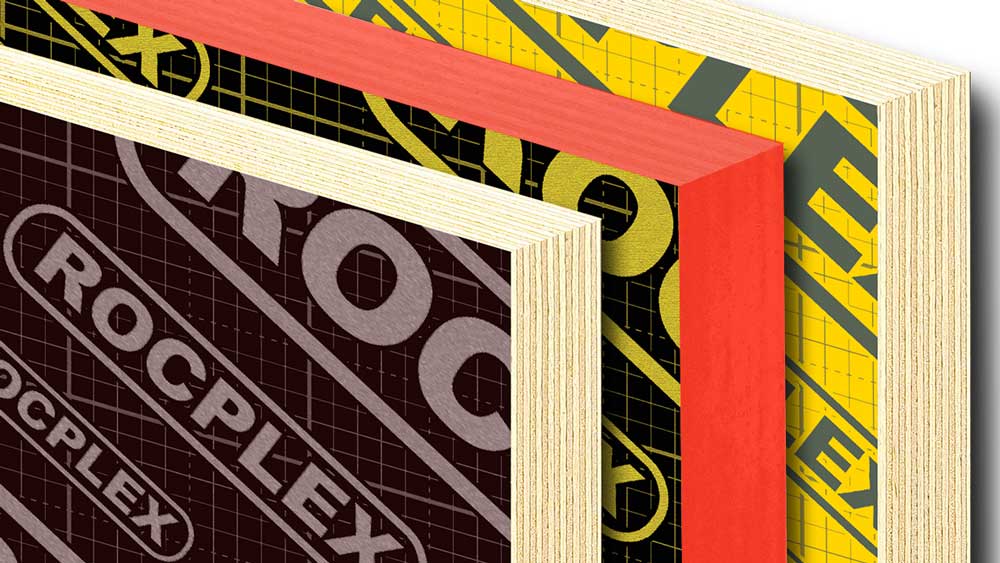
ROCPLEX Form Birch Film Faced Plywood
Film faced plywood should prove its value on site, not on paper. ROCPLEX Form Birch is a premium film faced plywood built for high reuse in concrete formwork. It aims to stay flat, release clean, and keep a stable face across repeat pours. The build focuses on three things that drive real cycles: 220 g/m² phenolic film on both sides, A-bond WBP bonding, and four-coat sealed edges. Full birch construction adds strength and stiffness for demanding routines. Share your size…
Post time: May-21-2026